


Efficient BEV Occupancy Annotation for Autonomous Driving: A Complete Guide
Bird's Eye View (BEV) occupancy annotation is becoming essential for next-generation autonomous driving systems. Unlike traditional object detection that focuses on individual entities, BEV occupancy provides a holistic, grid-based representation of the driving environment. This guide provides practical recommendations for annotating BEV occupancy data efficiently and accurately.
What is BEV Occupancy Annotation?
BEV occupancy represents the driving scene from a top-down perspective, dividing space into a grid where each cell indicates whether it's occupied, free, or uncertain. This approach provides several advantages:
- Complete spatial understanding: Captures the full geometry of the scene, not just discrete objects
- Better handling of ambiguous objects: Accounts for partially visible or difficult-to-classify entities
- Improved planning capabilities: Provides the dense spatial information needed for path planning and decision-making
Key Challenges in BEV Occupancy Annotation
1. Multi-Sensor Fusion Complexity
BEV occupancy requires accurate fusion of camera, LiDAR, and radar data. Annotators need tools that handle:
- Precise sensor calibration across multiple modalities
- Temporal aggregation to create dense point clouds
- Reference coordinate system management for consistent spatial representation
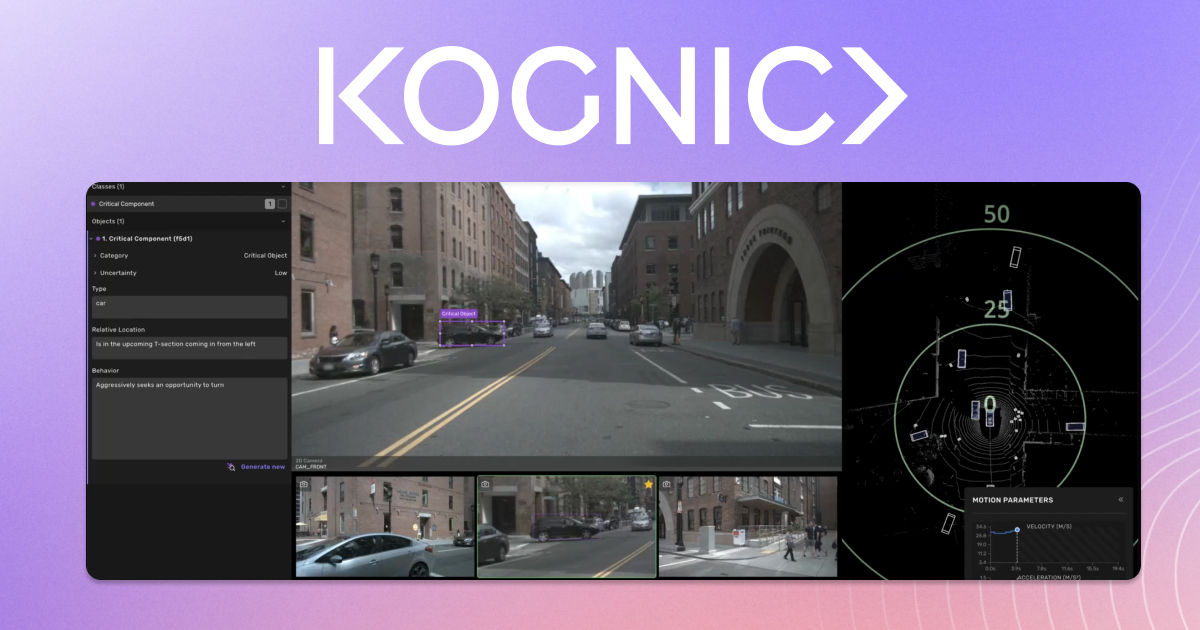
At Kognic, our platform natively supports sensor fusion with sophisticated engines, providing annotators with the complete context needed to make accurate occupancy judgments.
2. Defining Occupancy States
Not all space is simply "occupied" or "free." Your taxonomy should account for:
- Occupied: Space containing solid objects (vehicles, pedestrians, infrastructure)
- Free: Drivable or traversable space
- Unknown: Areas outside sensor range or occluded by other objects
- Dynamic vs. Static: Distinguishing between moving and stationary occupancy
3. Temporal Consistency
BEV occupancy annotations must maintain consistency across sequential frames. Objects moving through the scene need coherent occupancy patterns that reflect their motion and trajectory.
Recommended Annotation Workflow
Step 1: Establish Clear Guidelines
Before beginning annotation, define explicit rules for:
- Grid resolution (typical values: 0.2m to 0.5m per cell)
- Spatial extent (e.g., 50m x 50m around ego vehicle)
- Height ranges for occupancy determination
- Handling edge cases (partial occlusions, sensor artifacts, weather conditions)
Kognic's guideline agreement system ensures these rules are consistently applied across your annotation workforce.
Step 2: Leverage Pre-Annotations
Manual BEV occupancy annotation from scratch is prohibitively time-consuming. Use AI-assisted pre-annotations to:
- Generate initial occupancy grids from sensor data
- Reduce annotation time by 68% while maintaining quality
- Focus human expertise on correcting model uncertainties rather than creating annotations from scratch
Kognic's Co-Pilot system provides transparent pre-annotations with confidence scores, allowing annotators to quickly verify and refine the output.
Step 3: Annotate with Full Sensor Context
BEV occupancy cannot be accurately determined from a single sensor or viewpoint. Annotators need:
- Synchronized multi-camera views to understand object extent
- LiDAR point clouds for precise spatial measurements
- Potentially radar data for velocity information
- Temporal sequences to understand object motion and distinguish static from dynamic occupancy
Kognic's platform aggregates all sensor data into a coherent scene view, enabling annotators to make informed occupancy decisions with full context.
Step 4: Implement Robust Quality Assurance
BEV occupancy quality directly impacts downstream planning performance. Establish:
- Multi-stage review: Independent verification of initial annotations
- Consistency checks: Temporal coherence validation across sequences
- Metrics-based validation: Automated checks for common errors (floating occupancy, unrealistic transitions)
- Expert review loops: Escalation of complex scenarios to specialized annotators
Our quality assurance workflows integrate these checks directly into the production pipeline, catching errors before they impact model training.
Optimizing for Productivity
Curate Your Annotation Dataset
Not all data requires equal annotation effort. Use intelligent curation to:
- Identify high-value scenarios with complex occupancy patterns
- Find edge cases where your model is uncertain
- Balance representation across your operational design domain
Kognic's natural language search allows you to quickly find relevant scenarios (e.g., "construction zones with barriers" or "parking lots with multiple vehicles") without extensive metadata tagging.
Focus on Behavioral Context
BEV occupancy is moving beyond static geometry toward understanding intent and behavior. Consider annotating:
- Predicted future occupancy based on object trajectories
- Uncertainty regions where occupancy may change
- Semantic context (why is this space occupied? parking, construction, traffic incident?)
This shift toward behavioral annotation aligns with the industry's move to foundation models and vision-language-action (VLA) architectures.
Technical Considerations for Scale
Data Format and Standards
Use standardized formats for interoperability:
- ASAM OpenLABEL for annotation interchange
- Consistent coordinate systems across sensor modalities
- Version-controlled taxonomies that can evolve with your requirements
Compute and Storage
BEV occupancy grids can be large (50m x 50m at 0.2m resolution = 62,500 cells per frame). Plan for:
- Efficient compression and storage strategies
- Fast data loading for annotation tools
- Scalable processing pipelines for pre-annotation generation
The Kognic Advantage for BEV Occupancy
Kognic provides the most productive annotation platform for autonomy data, purpose-built to handle the complexity of BEV occupancy annotation:
- Price leadership: No one delivers more annotated autonomy data per dollar. Our AI-assisted workflows and expert workforce deliver up to 3x faster processing at significantly lower cost.
- Native sensor fusion: Built-in calibration and temporal aggregation provide the holistic scene understanding required for accurate occupancy judgment.
- Expert workforce: Our Perception Experts understand the physics and semantics of driving scenarios, not just geometric labeling.
- Scalable quality: Rigorous QA workflows ensure annotation accuracy below 0.5% error rates, meeting the standards required for L3+ autonomy.
Getting Started with BEV Occupancy Annotation
Ready to implement BEV occupancy annotation for your autonomous driving system? Here's how to begin:
- Define your occupancy taxonomy and grid parameters based on your operational design domain
- Select representative scenarios across your target ODD for initial annotation
- Establish clear guidelines with visual examples for edge cases
- Implement pre-annotation to accelerate the workflow
- Set up multi-stage QA processes to ensure consistency and accuracy
Kognic's Advisory Services team can guide you through this process, leveraging our experience with leading OEMs and Tier 1 suppliers developing next-generation autonomous systems.
Conclusion
BEV occupancy annotation represents the evolution from object-centric to scene-centric understanding in autonomous driving. By following these recommendations and leveraging purpose-built tools like Kognic's platform, you can create high-quality occupancy datasets efficiently and at scale.
The future of autonomy depends on data quality—not just data quantity. With the right annotation approach, you can build the foundation for safer, more capable autonomous systems.
Contact Kognic to discuss how we can support your BEV occupancy annotation needs and accelerate your path to production-ready autonomous driving.
Share this
Written by


.png)