waves-1
waves-2
bage-icon The leader in autonomy data annotation

Get the most annotated data for your budget

Every annotation counts. We ensure maximum throughput and quality, giving you the most data for your budget, without compromising on safety, trust, or productivity.

100 000 000+
Processed annotations by industry leaders
Up to 3x
Faster processing times to lower costs
Up to 68%
Time saved in annotation using auto-labels
hero-icon-left hero-icon-right
Zenseact
Qualcomm
Continental
Bosch
Kodiak
ZF
Embotech
Einride
Gatik
JLR
Sama

The data your models actually need

Unlock the potential of your models with our annotation solutions and overpowered platform, enabling human feedback at scale. 

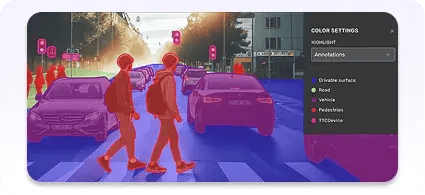
Semantic segmentation annotation showing drivable surface, road, vehicles, pedestrians, and traffic devices highlighted in different colors on an urban street scene
Annotation features
3D Cuboids
3D Multilidar cuboids
3D Polylines
3D Polylanes
3D Semantic segmentation
3D Points
3D Curves
2D Bounding box
2D Polygons
2D Points
2D Curves
Grouping of shapes
Pre-annotation support
Bounding Box Annotation
Text
Trajectory evaluation
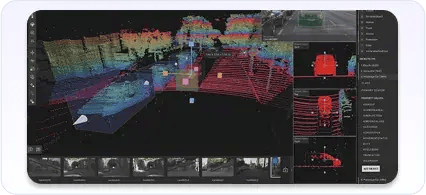
3D LiDAR point cloud annotation interface showing cuboid bounding boxes on vehicles in an urban scene
Multi-modal use cases
2D/3D Lane + road markings
2D/3D Dynamic objects
2D/3D Static objects
2D Instance segmentation
3D segmentation
Interior sensing
Scene classifcation
Trafic signs recognition
Trafic light recognition
Freespace annotation
Parking spot detection
Camera blockage annotation
Light source detection
Auto-label quality control
Driver monitoring annotation
Pre-label workfow
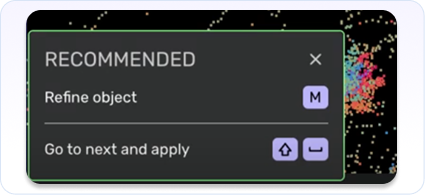
Kognic platform keyboard shortcuts showing recommended actions: refine object and go to next
Automation
Multi-sensor projections
Ego motion compensation
Segment anything model integration
2D/3D Objection tracking
2D/3D box auto adjust
2D Bbox from 3D cuboids projections
2D - 3D Semseg
Auto-filter static objects
Automatic static qualitychecks
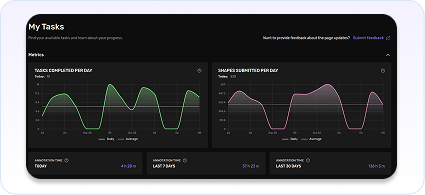
Annotator dashboard showing tasks completed per day and shapes submitted per day metrics
Project management
User statistics, including productivity
Role-based access levels
Role-based automatic taskallocation
Sandbox mode playground
APIs for data upload/export
Custom workfows
Taxonomy editor
Abstract illustration representing AI-assisted annotation workflow
Input format
Images: png, jpg, jpeg, webp and avif
Pointcloud: PCD, LAS, CSV
Abstract illustration representing human-in-the-loop feedback and collaboration
Export formats
OpenLABEL
Custom converters available
icon2

 Active Learning Labeling for Smarter Models

Why active learning matters

Reduce costs – Focus annotation budget on high-value samples only
Improve accuracy – Target the data gaps that limit model performance
Accelerate iteration – Shorter feedback loops between training cycles


Stop annotating data your model already understands. Kognic's active learning capabilities identify the samples that matter most—edge cases, uncertainties, and novel scenarios—so every annotation dollar drives real model improvement.

Continental Case Study
Zenseact case Study


Why Choose Kognic?

Leader in annotation for autonomy
A trusted partner for those shaping the future of autonomy and physical AI.
Most productive tools
Our annotation tools power your data pipelines to help you bring your products to market - faster and safer.
The pace your models need
We surface the data that matters most, helping your team detect and resolve critical issues with minimal effort.
Pioneers of annotation for physical AI
With a strong foundation in the automotive industry, we bring deep domain expertise and proven solutions to the most complex challenges.

Frequently Asked Questions

Kognic supports a comprehensive range of annotation types across both 3D and 2D data. In 3D, this includes cuboids, polylines, polylanes, semantic segmentation, points, and curves. In 2D, the platform handles bounding boxes, polygons, points, curves, and text annotations. These annotation types cover the full spectrum of autonomous driving perception tasks, from object detection and tracking to lane marking labeling and scene segmentation.

The platform supports a wide range of use cases critical to autonomous driving development. These include lane and road marking annotation, dynamic and static object labeling, instance segmentation, freespace detection, traffic sign classification, parking detection, interior sensing, driver monitoring, camera blockage detection, light source identification, and scene classification. Each use case comes with proven workflows and quality processes refined across production programs with leading customers.

Both. Kognic offers a flexible operations model that adapts to how your organization works. You can run annotation projects with your own internal teams using the Kognic platform, work with Kognic's managed annotation services for full-service delivery, or use a hybrid model with your preferred BPO partner operating on the platform. This flexibility means you control the tradeoff between cost, speed, and oversight based on your program's needs.

For input, the platform accepts common image formats (PNG, JPG, JPEG, WEBP, AVIF) and 3D point cloud formats (PCD, LAS, CSV). For output, Kognic supports OpenLABEL — the emerging industry standard for annotation data — as well as custom export converters tailored to your specific training pipeline requirements. This ensures labeled data integrates smoothly into your ML infrastructure without manual conversion steps.

Kognic's automation features can save up to 68% of annotation time compared to manual labeling. The platform integrates pre-labels from your own models or third-party sources, giving annotators a starting point to review and refine rather than creating labels from scratch. Additional automation includes multi-sensor projections, ego motion compensation, SAM-based segmentation, object tracking, automatic box adjustment, and static object filtering. These tools work together to let human annotators focus their effort where it matters most.

Active learning is a strategy that focuses your annotation budget on the data samples that will improve your model the most. Instead of labeling data randomly, the platform helps you identify high-value samples — scenes where your model is uncertain, encounters rare objects, or makes errors. By prioritizing these samples for annotation, you get better model performance with less labeled data. This targeted approach reduces overall annotation costs while accelerating model improvement.

Getting started typically begins with a demo and technical evaluation. You can request a demo to see the platform in action with your specific sensor configuration and annotation requirements. From there, Kognic's team works with you to define annotation guidelines, set up your project, and run a pilot on a representative sample of your data. Most teams go from first conversation to active annotation within a few weeks.

Ready to shape the future of Autonomy?

Learn how Kognic can help you scale human feedback at the pace of autonomy.

Contact Us