Encord Alternative for Autonomous Driving Annotation
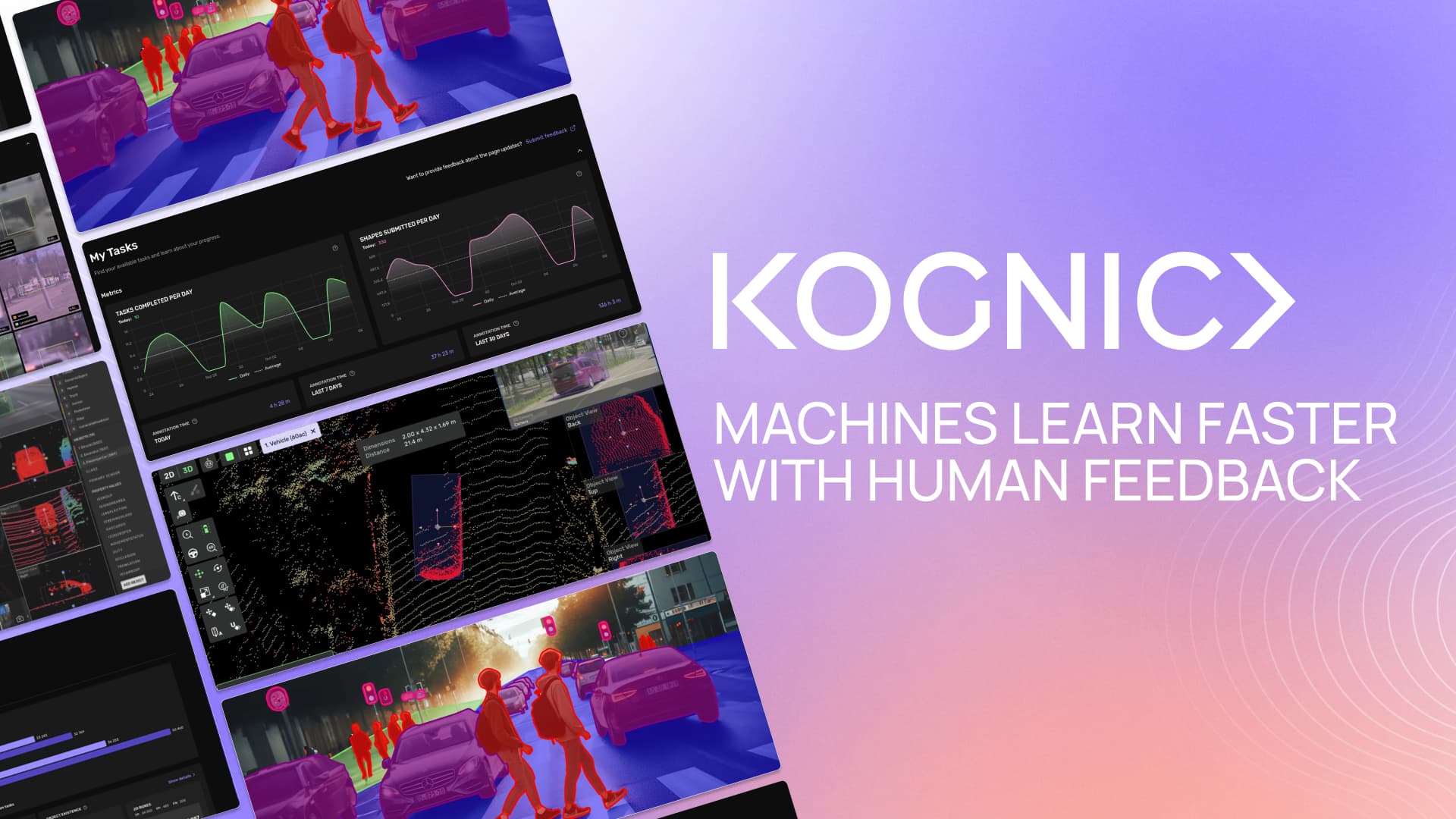
Kognic is a purpose-built annotation platform for autonomous driving and ADAS perception. Compared to Encord, Kognic offers deeper multi-sensor depth (camera + LiDAR + radar with calibrated coordinate mapping), 90+ automated quality checkers tuned for safety-critical data, TISAX Level 3 and ISO 27001 certification for automotive OEMs, and Language Grounding for the next generation of vision-language driving models. Encord is a broader multimodal labeling platform that adds general computer vision use cases including medical imaging and audio. For autonomous driving teams, Kognic provides more specialised 3D and sensor fusion tooling and a longer track record at production scale.
Built Different for a Reason
The autonomous driving market needs annotation infrastructure built for the problem. Camera, LiDAR, and radar data fused on calibrated coordinates. Quality assurance that flags geometric errors at scale. Workflows that handle multi-tier OEM review. Certifications that meet automotive supplier requirements. Kognic has spent seven years building exactly that, with over 100 million annotations delivered across 120+ programs at customers including Zenseact, Continental, Bosch, ZF, and Qualcomm.
Encord launched in 2020 with general-purpose computer vision annotation and added 3D and LiDAR capabilities in 2024. The platform is broad, covering medical imaging, audio, document AI, and ADAS. That breadth comes with trade-offs in 3D and sensor fusion depth that autonomy teams notice quickly during evaluation.
This article exists because Encord publishes a comparison page about Kognic that contains a number of statements that do not match how the Kognic platform actually works. Rather than ignore that, we wrote a transparent rebuttal with evidence. Where Encord has a legitimate edge, we say so.
Kognic vs Encord at a Glance
| Kognic | Encord | |
|---|---|---|
| Primary focus | Autonomous driving + ADAS perception | Multimodal CV (AV, medical, audio, docs) |
| Founded | 2018 | 2020 |
| Native LiDAR + 3D maturity | 7+ years production | <2 years |
| Multi-sensor fusion | Calibrated camera + LiDAR + radar with cross-sensor projection | Camera + LiDAR synchronization, calibration support added 2024 |
| Quality assurance | 90+ automated checker apps, Annotation Query Language (AQL) for custom checks | Configurable QA workflows |
| API + SDK | 25+ documented APIs, Python SDK (kognic-io) on PyPI | API + SDK |
| Auto-labeling | Autobaan ML predictions, one-click cuboids, pre-label integration | Active learning, model-assisted labeling |
| Workflow | Configurable multi-phase, multi-tier review, hybrid managed + tools | Configurable, self-serve and managed options |
| Per-annotator analytics | Judgement Edits API + Productivity Metrics API (per-user dashboards) | Project dashboards |
| Vision-language for VLM/VLA | Language Grounding (Write, Edit, Rank + Chain of Causation) | Multimodal labeling, no autonomy-specific VLA workflow |
| Certifications | TISAX Level 3 + ISO 27001 | SOC 2 + ISO 27001 |
| Customers in production AV | Zenseact, Continental, Bosch, ZF, Qualcomm, Kodiak, Embotech | Various |
Where Encord Has Legitimate Strengths
Transparency requires saying where the comparison runs the other way. Encord has the stronger marketed offering on:
Multimodal breadth across non-AV domains. Encord covers medical imaging, audio, document AI, and general computer vision. Kognic is purpose-built for autonomous driving and does not annotate audio or medical data. If your team needs one platform across multiple domains beyond autonomy, Encord is the broader fit.
When to Choose Kognic
Kognic is the right fit when:
- Your primary use case is autonomous driving perception, ADAS, or autonomy reasoning (VLM/VLA)
- You need calibrated multi-sensor annotation across camera, LiDAR, and radar with cross-sensor projection
- You require TISAX Level 3 certification for automotive OEM data handling
- You need configurable multi-tier QA with safety-critical reliability (90+ automated checkers)
- You want a partner with a managed-service option alongside platform tools, with full visibility into who is doing the work and how well
- You are planning for VLM/VLA capability and need vision-language annotation with Chain of Causation reasoning
When Encord Might Be the Better Fit
- Your use case spans medical imaging, audio, document AI, or general computer vision beyond autonomous driving
- Your team is small, self-serve only, with no managed-service requirement
Frequently Asked Questions
What is the best alternative to Encord for autonomous driving annotation?
Kognic is the leading alternative to Encord for autonomous driving annotation, with seven years of production 3D and LiDAR depth, calibrated multi-sensor fusion across camera, LiDAR, and radar, 90+ automated quality checkers, and TISAX Level 3 certification for automotive OEM data. Kognic has delivered over 100 million annotations across 120+ programs at Zenseact, Continental, Bosch, ZF, Qualcomm, and Kodiak. The platform also includes Language Grounding for VLM and VLA model training, an autonomy-specific capability not offered by Encord.
Does Kognic have an open API and SDK?
Yes. Kognic has 25+ documented APIs covering scene management, annotation operations, workflow orchestration, data integration, dataset quality, and per-user analytics. The Python SDK kognic-io is published on PyPI under MIT license with active development. The platform is API-first by design and supports programmatic project creation, sensor data upload, workflow management, and label export.
Is Kognic only for ADAS?
No. Kognic supports the full spectrum of autonomous driving development from ADAS through full autonomy. The platform also supports next-generation VLM and VLA models through Language Grounding, which launched in February 2026. Customers include ADAS programs at Tier-1 suppliers, full autonomous driving programs at OEMs, and autonomous trucking companies.
What sensors does Kognic support?
Camera (single, multi-camera, surround-view), LiDAR point clouds (including multi-LiDAR configurations), and radar. Sensors are annotated in a synchronized workspace with calibrated coordinate mapping that projects labels consistently across modalities.
Is Kognic TISAX certified?
Yes. Kognic is TISAX Level 3 and ISO 27001 certified. TISAX is the automotive industry standard for information security and is required by most European OEMs for vendors handling production vehicle sensor data.
How does Kognic handle quality assurance?
Kognic provides 90+ automated checker apps that flag geometric inconsistencies, missing labels, annotation guideline violations, and cross-sensor misalignments in real time. The Custom Checker API allows user-defined checks using Annotation Query Language. Configurable multi-tier review pipelines support FirstReview, SecondReview, ThirdReview, ClientReview, and OnboardingReview phases, with disputes and correction loops.
Does Kognic support pre-labels from existing models?
Yes. Pre-labels from your existing perception models are integrated as starting annotations. Annotators refine and correct rather than label from scratch, reducing annotation time by up to 68%.
What deployment models does Kognic offer?
Managed service, self-service platform license, and hybrid. The hybrid model combines Kognic platform tools with your preferred annotation workforce or partners.
See Kognic in action. Talk to our team about your autonomous driving program. We will walk you through the platform, your sensor stack, your data volumes, and the certifications you need.
Share this
Written by