Kognic vs Labelbox: Which Annotation Platform for Autonomous Driving?
Key Takeaways
- Labelbox is a strong multi-industry annotation platform with mature LLM RLHF tools, broad data type support, and a generous freemium tier. It is a great fit for teams with general AI labeling needs.
- Kognic is purpose-built for autonomous driving with 7+ years of production-grade 3D/LiDAR, native sensor fusion, and Language Grounding capabilities for next-generation VLM/VLA models.
- Neither platform is universally "better" -- the right choice depends entirely on what you are building. This comparison lays out the facts so you can decide.
- If your primary use case is autonomous driving annotation at production scale, the differences in 3D depth, sensor fusion, AV methodology, and customer track record matter significantly.
Disclosure: Kognic is the publisher of this comparison. We have made every effort to be factual and fair, using only publicly available information about Labelbox. We encourage you to evaluate both platforms firsthand.
Introduction
The data labeling market is crowded. Teams building AI products can choose from dozens of annotation platforms, each with different strengths, pricing models, and areas of focus. For many use cases -- text classification, image labeling for retail, medical imaging -- any well-designed platform will get the job done. But when evaluating Kognic vs Labelbox for autonomous driving, the details matter.
Autonomous driving is different. The sensor data is complex: LiDAR point clouds, multi-camera rigs, radar returns, all synchronized to the millisecond. The quality requirements are unforgiving because annotation errors become safety risks. And the annotation workflows themselves are evolving rapidly as the industry shifts from traditional perception models to vision-language models that need to understand not just what is in a scene, but why things happen.
This comparison looks at two platforms -- Kognic and Labelbox -- through the lens of autonomous driving annotation. We will cover what each platform does well, where each falls short, and how to decide which one fits your needs.
Company Overviews
Kognic
Kognic was founded in 2018 in Gothenburg, Sweden, with a single focus: annotation for autonomous driving and advanced driver-assistance systems (ADAS). The platform has been purpose-built from day one for the specific requirements of AV development -- 3D point cloud annotation, multi-sensor fusion, sequential frame labeling, and safety-critical quality assurance.
Kognic has delivered over 100 million annotations and works with OEMs and Tier 1 suppliers including Qualcomm, BMW, Zenseact, Continental, Bosch, Kodiak, ZF, Einride, Gatik, and Jaguar Land Rover. The company holds ISO and TISAX certifications and is headquartered in Sweden as an independent company.
In 2025 and 2026, Kognic expanded into Language Grounding -- vision-language annotation for VLM and VLA models -- adding Write, Edit, Rank, and behaviour annotation modes alongside its Chain of Causation methodology.
Labelbox
Labelbox was also founded in 2018, in San Francisco. CEO Manu Sharma co-founded the company and remains at the helm, providing leadership stability. Labelbox has raised approximately $189 million in funding at a roughly $1 billion valuation and employs between 230 and 364 people.
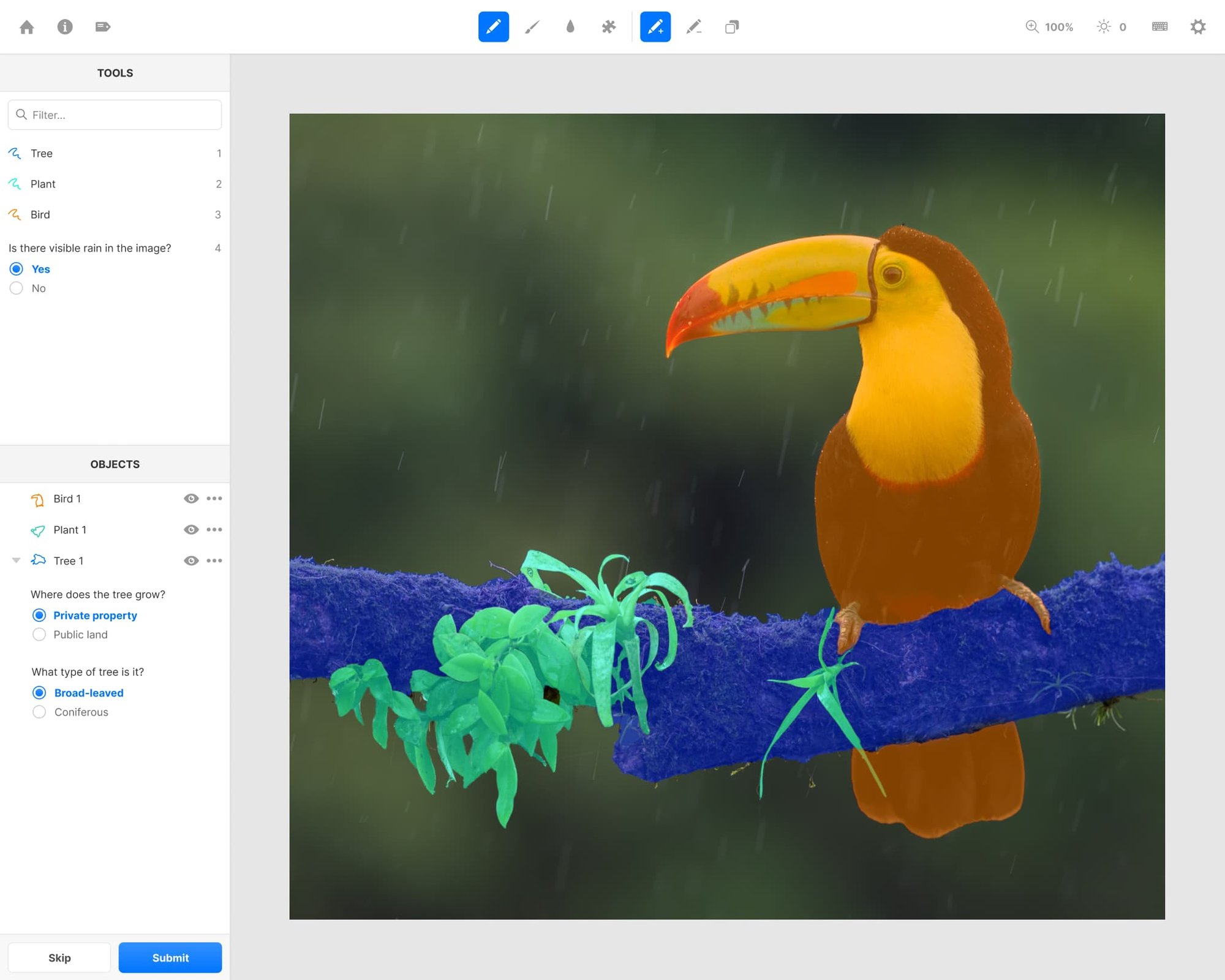
Labelbox is a multi-industry annotation platform supporting a broad range of data types: image, video, text, audio, PDF, geospatial, medical imaging, and multimodal chat. The platform serves enterprise customers across industries including Walmart, Google Cloud, Procter & Gamble, and NASA JPL. In recent years, Labelbox has invested heavily in LLM alignment tools, including RLHF workflows, model comparison, and its Alignerr services arm for expert human feedback on language models.
Kognic vs Labelbox: Feature Comparison
| Capability | Kognic | Labelbox |
|---|---|---|
| Primary focus | Autonomous driving and ADAS | Multi-industry AI data labeling |
| 3D / LiDAR annotation | Deep, production-grade (7+ years) | Available but not prominently featured |
| Sensor fusion | Native multi-sensor (camera + LiDAR + radar, synchronized) | Not documented as a core capability |
| Language Grounding / VLA | Chain of Causation methodology, Write/Edit/Rank, behaviour annotation | LLM text reasoning and RLHF (not driving-specific) |
| Data type breadth | Focused on AV sensor modalities | Broadest coverage (image, video, text, audio, PDF, geospatial, medical, chat) |
| RLHF / LLM tools | Not a core focus area | Mature, purpose-built (model comparison up to 10 models, LLM-as-judge, preference data) |
| Named AV customers | 10+ OEMs and Tier 1s (Qualcomm, BMW, Continental, Bosch, etc.) | None publicly named |
| Annotation services | AV domain experts | Alignerr (PhD-level, but LLM/STEM focused) |
| Quality assurance | 90+ purpose-built quality checker apps, guided workflows | Quality workflows and consensus |
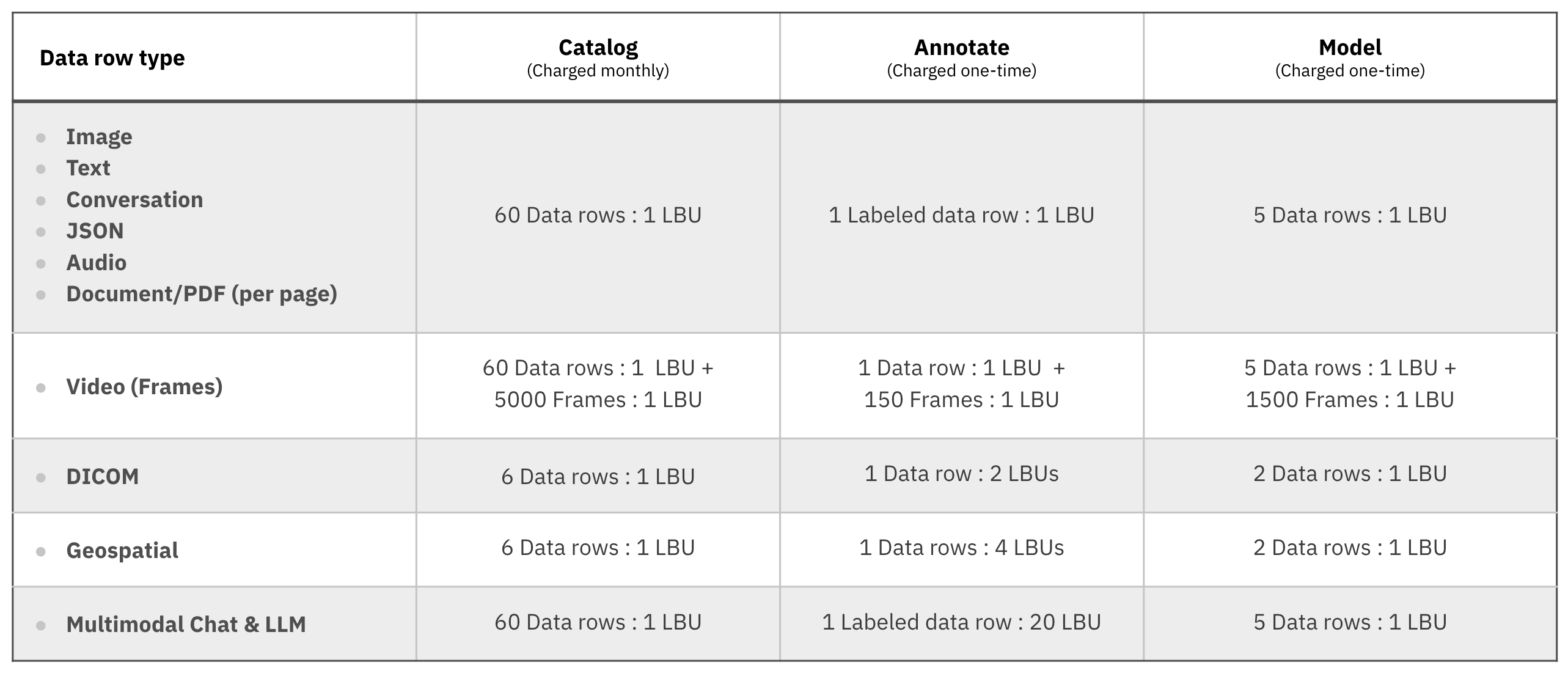
| Pricing model | Enterprise | Freemium + enterprise tiers |
| Certifications | ISO, TISAX | SOC 2, HIPAA |
| Headquarters | Gothenburg, Sweden | San Francisco, USA |
Where Labelbox Excels
Any fair comparison starts with what Labelbox does well. And they do several things very well. In several areas, Labelbox is the stronger choice.
Broadest data type support. Labelbox supports more data types than almost any other annotation platform on the market. If your team labels images, video, text transcripts, audio files, PDFs, geospatial data, and medical imaging, Labelbox can handle all of them in a single platform. This breadth is a real advantage for organizations with diverse AI initiatives across multiple business units.
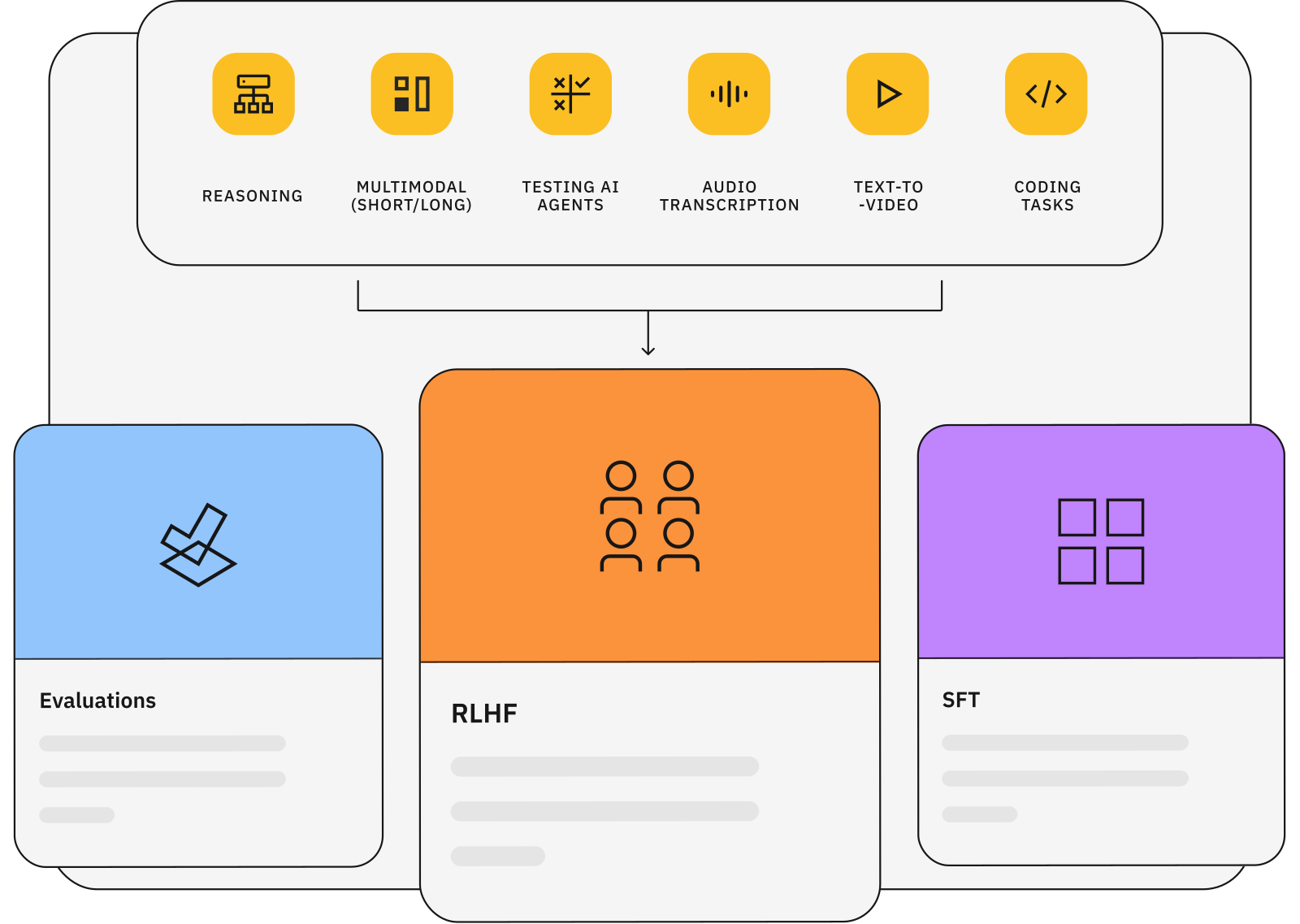
Mature, purpose-built LLM RLHF tools. For teams fine-tuning large language models, Labelbox has built some of the most sophisticated alignment tooling available. Their model comparison interface lets you evaluate up to ten models side-by-side. The multimodal chat editor handles complex conversational evaluation. LLM-as-judge and preference data workflows are mature and production-ready. If you are training or evaluating LLMs, Labelbox is a serious contender.
Freemium accessibility. Labelbox offers a free tier that lets teams start labeling immediately without a sales conversation. For smaller teams or those evaluating platforms, this low barrier to entry is genuinely valuable. You can build a proof of concept, label a meaningful dataset, and understand the tooling before committing budget.
Stable leadership and broad enterprise adoption. Co-founder Manu Sharma remains CEO, providing continuity. The customer base spans major enterprises across retail, aerospace, consumer goods, and government -- a sign of a platform that has been proven in production across many different contexts.
One platform for everything. If your organization needs a single annotation platform for multiple AI initiatives -- some involving LLMs, some involving computer vision, some involving document processing -- Labelbox's breadth means fewer vendor relationships and a unified workflow.
Where Kognic Excels
When the conversation turns specifically to autonomous driving, the differences become significant.
Purpose-built for autonomous driving. Kognic's entire platform, team, and roadmap exist to solve the annotation challenges specific to AV development. This is not a general-purpose tool with an AV module bolted on. Every design decision, from the point cloud rendering engine to the quality assurance framework, has been shaped by the requirements of teams building vehicles that need to operate safely in the real world.
Production-grade 3D and LiDAR. Kognic has been building 3D point cloud annotation tooling for over seven years. This is not a checkbox feature. Mature 3D tooling means fast and accurate cuboid placement, efficient multi-frame sequential labeling, support for dense and sparse point clouds across different LiDAR sensors, and multi-LiDAR workflows for vehicles running more than one scanner. The difference between early-stage 3D support and production-hardened tooling shows up in annotator throughput, label accuracy, and the ability to handle edge cases in real-world sensor data.
Native sensor fusion workflows. Modern AV perception stacks fuse data from cameras, LiDAR, and radar. Kognic's platform handles synchronized multi-sensor annotation natively -- annotators see the same object across sensor modalities and label it in a unified workflow. This ensures consistency between the 3D cuboid in the point cloud and the 2D bounding box in the camera image, which is critical for training fusion-based perception models.
Language Grounding and Chain of Causation. As the industry shifts toward vision-language models (VLMs) and vision-language-action models (VLAs), the annotation requirements are changing fundamentally. Models need to learn not just what is in a scene but why things happen and what the vehicle should do about it. Kognic's Language Grounding capability provides structured annotation modes -- Write, Edit, Rank, and behaviour annotation -- specifically designed for this new class of models. The Chain of Causation methodology prevents hindsight bias by controlling what annotators can see at each stage, producing cleaner reasoning data for model training.
A proven AV customer base. Kognic works with more than ten named OEMs and Tier 1 automotive suppliers. These are organizations that have evaluated annotation platforms specifically for autonomous driving and chosen Kognic. That track record is meaningful. It signals that the platform has been tested against real AV annotation requirements -- scale, quality, security, and the specific workflows that automotive programs demand.
AV-specific quality assurance. Kognic has built over 90 quality checker applications purpose-designed for autonomous driving annotation. These are not generic quality tools -- they check for the kinds of errors that matter in AV data: incorrect cuboid orientations, inconsistent track IDs across frames, labels that violate physical constraints, and dozens of other domain-specific quality rules. Guided annotation workflows further reduce error rates by structuring the annotation process to prevent common mistakes.
Key Differences: A Deeper Look
Beyond the feature comparison, three structural differences define how these platforms serve autonomous driving teams.
Specialist vs. Generalist: Depth Beats Breadth for Safety-Critical Work
Labelbox's strategy is to be the annotation platform for all AI. That is a legitimate business model, and for many organizations it is the right choice. But there is an inherent trade-off. A platform that serves healthcare, retail, agriculture, media, government, and automotive cannot invest as deeply in any one domain as a platform focused entirely on that domain.
In most software categories, generalist tools are good enough. But autonomous driving annotation is unusually demanding. The data is three-dimensional, multi-modal, and sequential. The quality bar is set by safety requirements, not just model accuracy metrics. The workflows are evolving rapidly as new model architectures (VLMs, VLAs, world models) change what annotation teams need to produce. A team working on safety-critical AV perception does not just need "3D support." They need tooling that has been refined over thousands of real annotation projects, shaped by feedback from the engineering teams at major automotive OEMs.
Both approaches are valid. The question is which one matches your requirements. When the domain is safety-critical and technically complex, depth matters.
AV Customer Track Record: Proven vs. Unproven
Perhaps the most telling data point in this comparison is the customer list. Kognic publicly names more than ten OEMs and Tier 1 automotive suppliers as customers. Labelbox does not publicly name a single automotive customer.
This does not necessarily mean no automotive company has ever used Labelbox. But it does mean that automotive is not a segment Labelbox leads with or has built significant reference customers in. For an AV team evaluating annotation platforms, reference customers matter. They confirm that the platform has handled the specific data formats, scale requirements, security standards (ISO, TISAX), and workflow complexity that automotive programs require. When you are choosing a platform for a production annotation pipeline that feeds a safety-critical perception stack, having verifiable proof that other serious AV programs rely on the same platform reduces risk considerably.
Product Roadmap Direction: Where Each Platform Is Heading
Labelbox's recent investments have been heavily focused on LLM alignment and generative AI. The Alignerr services arm, the multimodal chat editor, the model comparison tools -- these all point toward a product roadmap oriented around language models and generative AI evaluation. This makes strategic sense given the explosive growth of the LLM market.
Kognic's roadmap is moving deeper into autonomous driving, specifically into the capabilities that next-generation VLM and VLA models require. Language Grounding, Chain of Causation, behaviour annotation, and LLM integration for autolabeling and online automation are all investments in the future of AV annotation, not general-purpose AI.
For AV teams, the question is straightforward: Which platform is more likely to build the specific capabilities you will need eighteen months from now? If your roadmap involves VLMs that need reasoning data, VLAs that need preference learning, or world models that need behaviour annotation, a platform whose roadmap is focused on those exact problems is more likely to deliver the tooling you need when you need it.
When to Choose Which
.jpg?width=1062&height=640&name=kognic-vs-labelbox-decision-flowchart%20(1).jpg)
Choose Labelbox if:
- You need a single platform for diverse AI initiatives. If your organization labels text, images, audio, medical data, and video across multiple teams and use cases, Labelbox's breadth is a genuine advantage.
- Your primary challenge is LLM alignment. Labelbox's RLHF tools, model comparison, and Alignerr services are purpose-built for fine-tuning and evaluating large language models.
- You want to start small. The freemium tier lets you evaluate the platform and label initial datasets without budget commitment.
- Autonomous driving is not your primary use case. If AV annotation is a small part of a larger labeling operation, a generalist platform may simplify vendor management.
- You value breadth over depth. For teams that need good-enough coverage across many data types rather than specialized tooling for one domain.
Choose Kognic if:
- Autonomous driving or ADAS is your primary use case. The platform, team, roadmap, and customer base are built around this domain.
- You need production-grade 3D and LiDAR annotation. Mature 3D tooling with multi-LiDAR support and efficient sequential labeling.
- Sensor fusion is a requirement. Native multi-sensor annotation with synchronized camera, LiDAR, and radar workflows.
- You are building or training VLM/VLA models. Language Grounding capabilities (Write, Edit, Rank, behaviour annotation) and Chain of Causation methodology are designed specifically for this.
- Quality and safety are non-negotiable. Over 90 AV-specific quality checker apps, ISO and TISAX certifications, and guided annotation workflows.
- You want a proven AV partner. Verifiable reference customers across major OEMs and Tier 1 suppliers with over 100 million annotations delivered.
Conclusion
Kognic and Labelbox are both well-built annotation platforms, but they are built for different problems. Labelbox is one of the strongest multi-industry annotation platforms available, with particular strengths in LLM alignment and data type breadth. For teams with broad AI labeling needs, it is a smart choice.
Kognic is built specifically for autonomous driving. If your team is developing perception, planning, or end-to-end models for autonomous vehicles, the differences in 3D/LiDAR depth, sensor fusion, AV methodology, quality assurance, and customer track record are not marginal -- they are fundamental to annotation quality, throughput, and the ability to support next-generation model architectures.
Different problems call for different tools. For autonomous driving teams building the next generation of models, the platform that goes deepest into 3D, sensor fusion, and reasoning annotation is the one that will help machines learn fastest from human feedback.
Some organizations will use both. Labelbox for LLM alignment and multi-modal labeling across business units. Kognic for the autonomous driving annotation pipeline. Using the right tool for each job is better than forcing one platform to do everything.
Building autonomous driving models? See how Kognic handles multi-sensor annotation at production scale.
This comparison was published by Kognic using only publicly available information about Labelbox as of February 2026. We encourage readers to evaluate both platforms firsthand.
Share this
Written by