Scale AI Alternative for Autonomous Vehicles
Purpose-built annotation for teams who need sensor fusion done right.
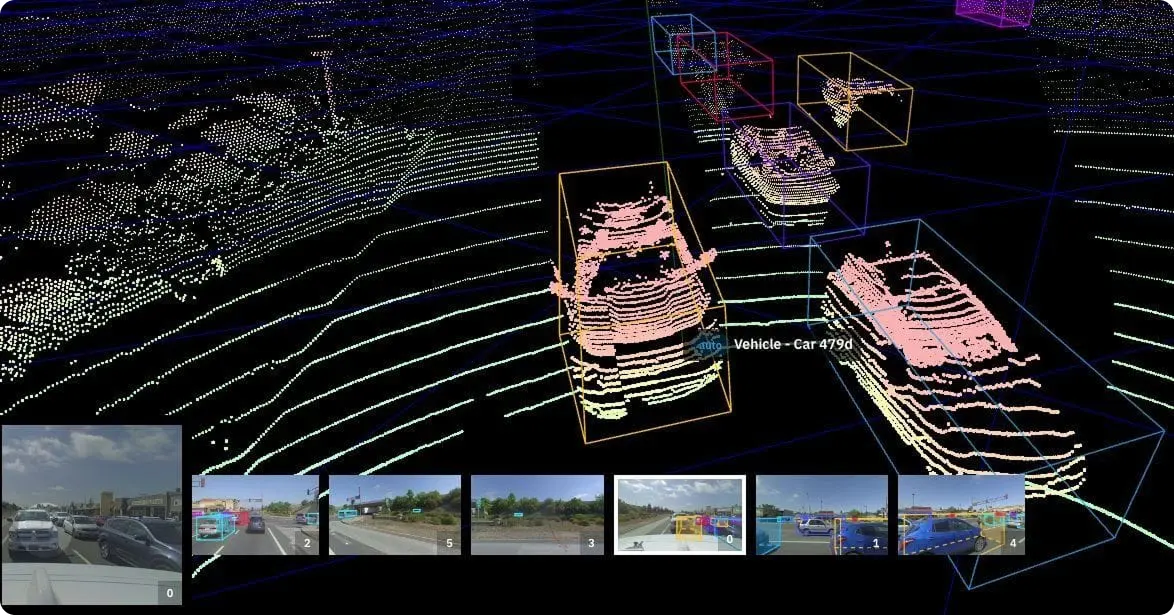
Scale AI built a platform for every industry. Kognic built one for yours. Native 3D point cloud handling, physics-based sensor fusion, and domain experts who understand autonomy. Not gig workers labeling groceries between your LiDAR frames.
Scale AI started in 2016 labeling images for e-commerce and general computer vision. Today they serve dozens of industries—from LLM training to document processing to defense.
For autonomy teams, this means working with tools that treat 3D point clouds as a visualization layer, not a physics simulation. Their platform projects LiDAR onto camera images rather than natively handling ego-motion compensation, time synchronization, and sensor calibration.
Multi-LiDAR setups with overlapping fields of view? Complex fisheye distortion models? These require significant custom configuration or "servicing" from Scale's engineering team—not self-serve capabilities.
Common frustrations:
- Converting data to proprietary SFS format introduces ETL burden and potential errors
- 3D interfaces feel like "independent data streams visually overlaid" rather than fused
- Adjusting pre-labels on rotated 3D cuboids often harder than drawing from scratch
Scale AI's strength is scale—access to hundreds of thousands of gig workers worldwide through Remotasks. But autonomous vehicle annotation isn't a volume game. It's a judgment game.
A pedestrian standing still at a crosswalk: are they about to step into traffic? A dark shape on the road: plastic bag or small animal? These edge cases require expert judgment, not crowd consensus.
Gig workers labeling LiDAR today might be labeling grocery receipts tomorrow. High turnover prevents "tribal knowledge"—the intuitive understanding of your specific sensor quirks, test routes, and error patterns. Workers paid per task are incentivized by speed, creating structural conflict with the precision safety-critical systems demand.
The risk is real: The U.S. Department of Labor has investigated Scale AI for potential labor violations. As the EU AI Act mandates supply chain transparency, relying on this model becomes a compliance liability.
Every platform promises AI-assisted labeling. Scale AI markets "GenAI Data Engines" and "Automated Data Labeling" suggesting AI does the heavy lifting with minimal oversight.
The reality: industry analysis shows these tools often "hallucinate" or produce results requiring 100% human review. A pre-label that's 90% correct can actually cost more than manual labeling—because humans must "fight" the tool to correct the 10% error.
One analysis found poorly-tuned auto-labeling can increase total annotation time by 15-20%. Scale's marketing focuses on initial pass speed while glossing over this "last mile" difficulty.
What actually works: treating model predictions as intelligent prompts that guide human attention, not replace it. Automation that knows its confidence limits. Quality-first routing that surfaces edge cases for expert review instead of burying them in crowd consensus.
Built Different for a Reason
|
|
|
|---|---|---|
| Industry Focus | Generalist across LLMs, defense, e-commerce, automotive | Purpose-built exclusively for autonomous driving |
| Workforce | Gig economy crowd with high turnover | Trained domain experts with account continuity |
| Quality Method | Statistical consensus from multiple workers | Expert-led with engineering specifications |
| Platform Access | Black box - limited visibility into process | White box - full transparency and Review API |
| Iteration Speed | Weeks for new batches and guideline changes | Real-time curation and correction chunks |
| Automation Reality | Heavy marketing, often requires 100% human rework | "Co-pilot" approach - AI assists, humans verify |
| Integration | Proprietary formats, vendor lock-in risk | ASAM OpenLABEL standard, high interoperability |

Frequently Asked Questions
Scale AI is the dominant name in general-purpose data annotation, with particular strength in LLM RLHF and text labeling. Kognic is purpose-built for autonomous driving annotation, with deep 3D/LiDAR expertise, native sensor fusion, and Language Grounding capabilities designed for next-generation vision-language-action models. The right choice depends on your use case: Scale AI for LLM annotation at scale, Kognic for autonomous driving systems.
Kognic has 7+ years of production-proven 3D annotation with one-click cuboid creation, smart interpolation, and multi-LiDAR workflows. Scale AI's foundation model AFM-1 is focused on 2D image understanding — 3D capabilities exist but are not the platform's primary strength. For teams where LiDAR annotation quality is critical, Kognic's purpose-built platform offers significantly deeper tooling.
As of 2025, Meta holds a 49% stake in Scale AI, and founder Alexandr Wang departed to join Meta as VP of AI. Several major customers — including Google, OpenAI, and Microsoft — ended their relationships citing concerns about data conflicts. Kognic remains fully independent with no majority ownership by any technology company that competes with its customers, which matters for OEMs and Tier-1 suppliers handling sensitive pre-production data.
Kognic includes over 90 automated checker apps specifically designed for autonomous driving — catching cuboid errors, tracking ID switches, and cross-sensor inconsistencies. Quality assurance runs continuously throughout the annotation process. Scale AI's quality processes are designed for broader use cases including text, image classification, and LLM preference ranking. For safety-critical automotive work, Kognic's domain-specific QA methodology provides deeper coverage.
Scale AI's RLHF capabilities are designed for text and language models — training ChatGPT-style systems. It does not offer driving-specific reasoning annotation. Kognic's Language Grounding capabilities include Write, Edit, Rank, and Behaviour annotation modes specifically designed for vision-language-action model training, capturing not just what is in a scene but why things happen. Learn more about our annotation solutions.
Scale AI's customer base has shifted toward defense contracts ($100M DoD, $99M Army) and LLM companies. Kognic serves leading automotive OEMs and Tier-1 suppliers including Qualcomm, Zenseact, Continental, and Bosch, with over 100 million annotations delivered. Kognic holds ISO 27001 and TISAX certifications required by automotive customers.
Request a demo to see the platform with your sensor configuration. Kognic's team will help you define annotation guidelines, set up your project, and run a pilot. Most teams go from first conversation to active annotation within a few weeks. If you're migrating from another platform, Kognic supports standard data formats including OpenLABEL for smooth transitions.