

Sensor Fusion Annotation for Autonomous Vehicles: A Complete Guide
Key Takeaways
- Sensor fusion annotation means labeling camera, LiDAR, and radar data in a single coordinated workflow rather than annotating each sensor stream separately.
- Annotating sensors together prevents consistency errors, captures cross-sensor context, and cuts duplicated effort compared to independent annotation pipelines.
- Calibration is the foundation. Poor extrinsic or intrinsic calibration is the single largest source of annotation quality issues in multi-sensor workflows.
- Production-grade sensor fusion annotation requires synchronized multi-view rendering, sequence handling, automated cross-sensor quality checks, and pre-labeling integration.
- Kognic's platform was built for multi-sensor autonomous driving data from day one, with 90+ automated quality checkers purpose-built for this use case.
What Is Sensor Fusion Annotation?
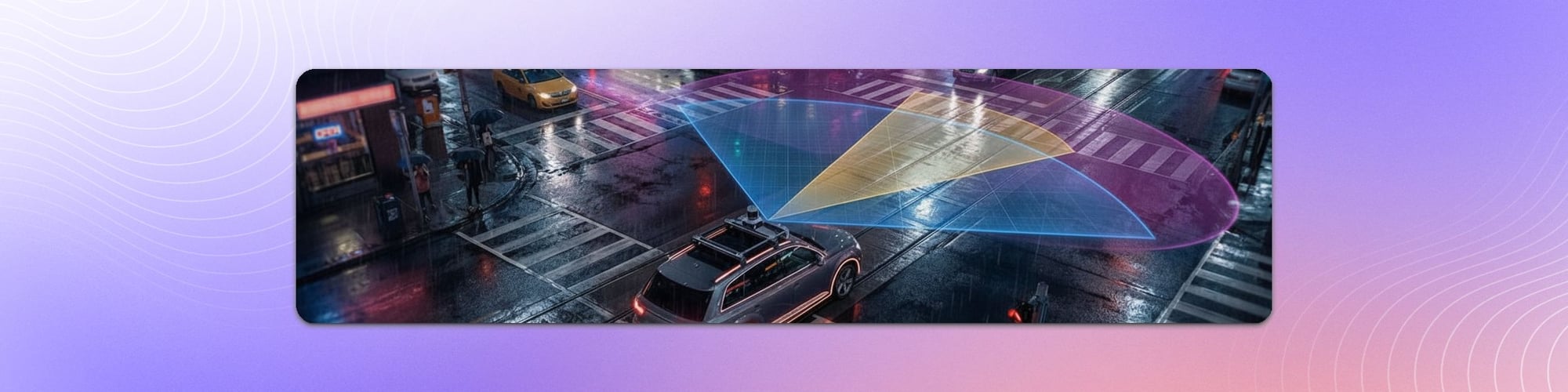
Sensor fusion annotation is the process of labeling data from multiple sensor types within a single, coordinated workflow. Instead of annotating camera images and LiDAR point clouds separately, annotators work across synchronized views of all sensors at once.
This matters because autonomous vehicles don't rely on a single sensor. A production perception stack typically combines cameras (for color, texture, and resolution), LiDAR (for precise 3D geometry and distance), and radar (for velocity measurement and weather resilience). Each sensor has strengths the others lack. A camera sees a stop sign's text but can't measure distance. LiDAR measures distance precisely but can't read text. Radar tracks velocity through fog but lacks spatial detail.
The goal of sensor fusion annotation is to produce ground truth that reflects what the vehicle actually perceives: a unified representation of the world from all sensors simultaneously.
Why Annotate Sensors Together, Not Separately?
Teams sometimes start by annotating each sensor stream independently. Camera images get 2D bounding boxes. Point clouds get 3D cuboids. The labels are merged later.
This approach breaks down quickly for three reasons.
Consistency errors. A pedestrian labeled in the camera feed might not align with the corresponding points in the LiDAR cloud. Small mismatches compound across thousands of frames, creating noisy training data that degrades model performance.
Missing cross-sensor context. Some objects are only partially visible in one modality. A dark vehicle might blend into shadows in the camera view but stand out clearly in the point cloud. Annotating sensors in isolation means the camera annotator might miss what the LiDAR annotator catches, and vice versa.
Duplicated effort. When an annotator labels a vehicle in the camera view and a separate annotator labels the same vehicle in the point cloud, you're paying twice for the same object. A fused workflow lets one annotator create a single label that projects across all sensor views.
Camera + LiDAR Fusion Workflows
The most common sensor fusion workflow in autonomous driving combines camera images with LiDAR point clouds. Here's how a production workflow typically operates.
Synchronized Visualization
The annotation platform displays all sensor views simultaneously: multiple camera angles, the 3D point cloud, and often a bird's-eye-view (BEV) projection. Annotators can rotate the point cloud, click into any camera view, and see how a single annotation appears across all perspectives.
When an annotator draws a 3D cuboid around a vehicle in the point cloud, the platform automatically projects that cuboid onto each camera image using the sensor calibration data. The annotator can fine-tune the fit in whichever view gives the best perspective.
Adding Radar to the Mix
Radar data adds velocity information and weather resilience. In a three-sensor fusion workflow, radar points overlay the point cloud or BEV, giving annotators another signal for identifying and tracking moving objects. This is particularly valuable for objects at long range where LiDAR points become sparse.
Temporal Fusion: Sequences, Not Single Frames
Real-world perception operates on sequences, not snapshots. Production annotation workflows process multi-frame sequences where objects are tracked across time. An annotator assigns a track ID to a vehicle in frame one, and the platform propagates that identity across subsequent frames. The annotator corrects drift and handles occlusions as they go.
Temporal consistency across sensors adds another dimension: the same object must maintain its identity not just across time, but across all sensor views at each timestamp.
Calibration: The Foundation of Everything
Sensor fusion annotation only works if the platform knows exactly how each sensor relates to every other sensor in 3D space. This is calibration, and it's non-negotiable.
What Calibration Provides
Extrinsic calibration defines where each sensor sits relative to the vehicle's reference frame: its position and orientation. This allows the platform to project a 3D point cloud label onto 2D camera images accurately.
Intrinsic calibration describes each camera's internal properties: focal length, principal point, and lens distortion. Without accurate intrinsics, projected annotations will drift from the actual objects in the image.
When Calibration Goes Wrong
Poor calibration is the single most common source of annotation quality issues in multi-sensor workflows. Symptoms include 3D cuboids that appear misaligned when projected onto camera views, track IDs that jump between objects across frames, and annotators spending excessive time on manual corrections.
Production teams should validate calibration before any annotation begins. A good platform will flag calibration anomalies automatically rather than letting annotators struggle with misaligned data.
Cross-Sensor Quality Validation
Quality assurance in sensor fusion annotation goes beyond checking individual labels. The validation must verify consistency across sensors.
Projection Checks
Every 3D annotation should project correctly onto all camera views. Automated checks can flag cases where a cuboid's projection falls outside the visible object boundary in any camera, indicating either a labeling error or a calibration issue.
Spatial Consistency
Objects that appear in overlapping sensor fields of view should have annotations that agree. If a LiDAR-derived cuboid says a vehicle is 45 meters away, but the camera-based depth estimate from the annotation's projection suggests 50 meters, something needs investigation.
Track Continuity
For sequences, quality checks verify that track IDs remain consistent across all sensors and time steps. A vehicle that's track ID 7 in the point cloud at frame 100 should still be track ID 7 in the camera annotations at frame 100, and in both modalities at frame 200.
Kognic's platform includes over 90 automated quality checker applications built specifically for autonomous driving data. These checkers catch issues like incorrect cuboid orientations, inconsistent track IDs, and cross-sensor misalignments before they enter your training pipeline.
Tools and Platform Requirements
Not every annotation platform can handle real sensor fusion. Here's what to look for.
Native multi-sensor support. The platform should render camera, LiDAR, and radar data in synchronized views out of the box. Bolted-on 3D support (common in platforms that started with 2D image annotation) typically lacks the performance and accuracy needed for production work.
Calibration ingestion. The platform needs to accept your calibration data in standard formats and apply it correctly across all visualizations and projections.
Sequence handling. Single-frame annotation tools don't cut it for temporal fusion. The platform must support multi-frame sequences with interpolation, track management, and efficient navigation.
Scalable QA. Manual review doesn't scale. Automated quality checks that run on every annotation, checking cross-sensor consistency, are essential for production volumes.
Pre-labeling integration. Your models' predictions should feed back into the annotation pipeline as pre-labels, reducing manual effort while maintaining quality through human review.
How Kognic Handles Multi-Sensor Annotation
Kognic's platform was built from day one for multi-sensor autonomous driving data. Annotators work in a unified interface that displays synchronized camera, LiDAR, and radar views with full calibration support.
Key capabilities include:
- True sensor fusion: Annotations created in any view automatically project across all synchronized sensors. A cuboid drawn in the point cloud appears correctly in every camera image.
- 90+ quality checkers: Purpose-built for driving data. Automated validation catches cross-sensor misalignments, track breaks, and geometry errors before delivery.
- Pre-labeling and automation: Integrate your model predictions as starting points. Annotators refine rather than create from scratch, with up to 68% time savings on annotation tasks.
- 4,000+ trained annotators: Not just a platform. Kognic provides AV-specialist annotators who understand the domain, reducing ramp-up time and improving first-pass quality.
- Multi-tier review workflow: Configurable review pipelines (first review, second review, client review, and onboarding review) keep annotation quality consistent across large annotator teams, so quality holds as a project scales up in headcount.
- Production-proven at scale: Over 100 million annotations delivered to OEMs and Tier 1 suppliers including Qualcomm, Continental, and Zenseact.
Sensor fusion annotation is where annotation quality is won or lost. The more sensors involved, the more opportunities for misalignment and the higher the cost of errors in your training data. Getting it right starts with a platform built for multi-sensor data from the ground up.
Frequently Asked Questions
What is sensor fusion annotation?
Sensor fusion annotation is the process of labeling data from multiple sensor types (typically cameras, LiDAR, and radar) within a single coordinated workflow. Annotators work across synchronized views of all sensors at once, producing ground truth that reflects what the vehicle actually perceives.
How does camera and LiDAR fusion annotation work?
The annotation platform displays camera images and the LiDAR point cloud simultaneously and uses sensor calibration to project labels across views. When an annotator draws a 3D cuboid in the point cloud, that cuboid automatically projects onto each camera image so the annotator can verify and refine the fit.
Why is calibration important for sensor fusion annotation?
Calibration tells the platform exactly how each sensor relates to every other sensor in 3D space. Without accurate extrinsic and intrinsic calibration, projected annotations drift and cross-sensor consistency breaks down, making poor calibration the most common source of annotation quality issues.
What quality checks apply to multi-sensor annotation?
Production workflows validate that every 3D annotation projects correctly onto all camera views, that spatial estimates agree across sensors, and that track IDs stay consistent across time and modalities. Automated checkers flag cross-sensor misalignments before annotations reach the training pipeline.
Can you annotate cameras and LiDAR separately and merge the labels later?
You can, but it degrades quality fast. Independent annotation creates consistency errors where labels do not align across sensors, misses cross-sensor context where one modality sees what another cannot, and doubles the annotation cost because the same object gets labeled multiple times.
What should I look for in a sensor fusion annotation platform?
Look for native multi-sensor support, calibration ingestion in standard formats, multi-frame sequence handling, automated cross-sensor quality checks, and pre-labeling integration that uses your model predictions as a starting point. Platforms that started as 2D image tools typically lack the performance and accuracy needed for production multi-sensor work.
Ready to see how sensor fusion annotation works in practice? Request a demo to explore Kognic's multi-sensor annotation platform with your own data.
Share this
Written by


.jpg)