Autonomous Driving Annotation: The Complete Guide
Autonomous driving annotation is the process of labeling sensor data, including camera images, LiDAR point clouds, and radar returns, so that an autonomous vehicle's perception and planning models can learn to recognize objects, road structure, and behavior. It turns raw drive logs into ground truth: the verified examples a model trains against. Because autonomous driving is safety-critical, the annotations must be accurate, consistent across sensors, and traceable through a quality-assured pipeline.
A self-driving system is only as good as the data it learns from. A perception model does not understand a pedestrian, a cut-in, or a faded lane line on its own. It learns those from labeled examples. Annotation is where human judgment gets encoded into training data, and where most of the cost, time, and quality risk in an autonomy program sits.
This guide covers what autonomous driving annotation is, the annotation types used across sensors, the use cases that depend on each one, the quality requirements that separate production-grade data from noise, and how annotation fits into a model development pipeline.
Key Takeaways
- Autonomous driving annotation labels camera, LiDAR, and radar data to create ground truth for AV perception and planning models.
- The main annotation types are 2D camera annotation, 3D cuboids on LiDAR point clouds, semantic and instance segmentation, lane and road annotation, and behavior or language annotation.
- Sensor fusion annotation labels camera, LiDAR, and radar together in one coordinated workflow, which keeps labels consistent across sensors.
- Quality matters more in autonomous driving than in most domains because errors propagate into safety-critical decisions.
- Pre-labeling and automated checks reduce manual effort, but human review remains the control point for quality.
What Is Autonomous Driving Annotation?
Autonomous driving annotation labels the raw output of a vehicle's sensors so that machine learning models can be trained and validated against verified examples. The labels mark what is in the scene, where it is in three dimensions, how the road is structured, and increasingly, why a situation matters and what the vehicle should do.
An autonomous vehicle perceives the world through several sensor types, each with different strengths. Cameras capture color, texture, and the semantic detail needed to read signs and lane markings. LiDAR produces dense 3D point clouds that measure distance and object geometry precisely. Radar measures velocity and range reliably, including in rain, fog, and low light. No single sensor is enough on its own, so most AV stacks combine them. Annotation has to keep up with that, which is why multi-sensor work has become the default rather than the exception.
The output of annotation is ground truth. Ground truth is the reference set a model is trained and measured against. If the ground truth is wrong, the model learns the wrong thing, and no amount of model tuning fixes data that was mislabeled at the source.
What Are the Main Types of Autonomous Driving Annotation?
There are six annotation types that matter most for autonomous driving. Each maps to a different sensor and a different model task.
3D and LiDAR Point Cloud Annotation
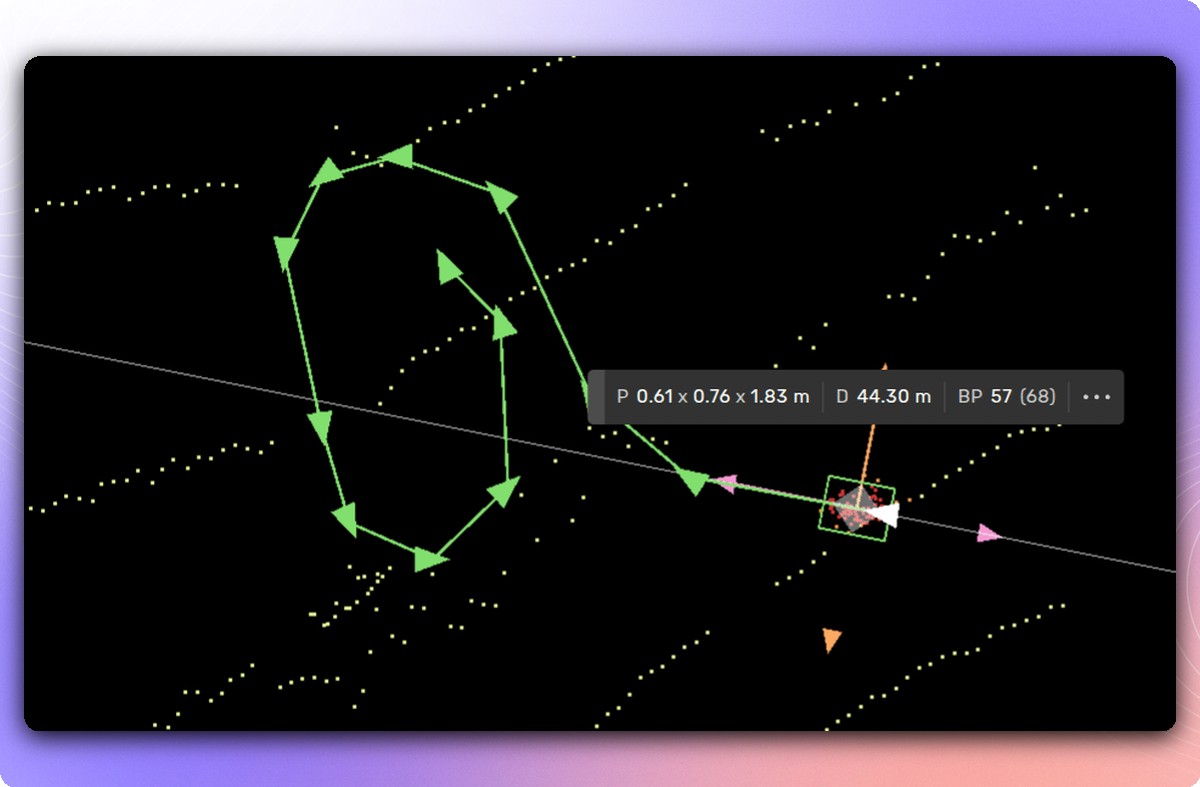
3D annotation places oriented cuboids, called 3D bounding boxes, around objects inside a LiDAR point cloud. Each cuboid records the object's position, dimensions, and yaw, which is the direction it faces. That orientation is what lets a prediction model reason about where a vehicle is heading.
LiDAR is the backbone of most AV perception stacks because it measures depth directly rather than inferring it. Annotating point clouds is harder than annotating images: the data is sparse, it is three-dimensional, and objects far from the sensor may be only a handful of points. This is the area where general-purpose labeling tools tend to fall short and where AV-specific platforms earn their place.
On the Kognic platform, 3D annotation runs natively on point cloud data, and object tracking keeps an object's identity consistent across the frames of a sequence rather than treating each frame as a fresh scene.
Camera and 2D Annotation
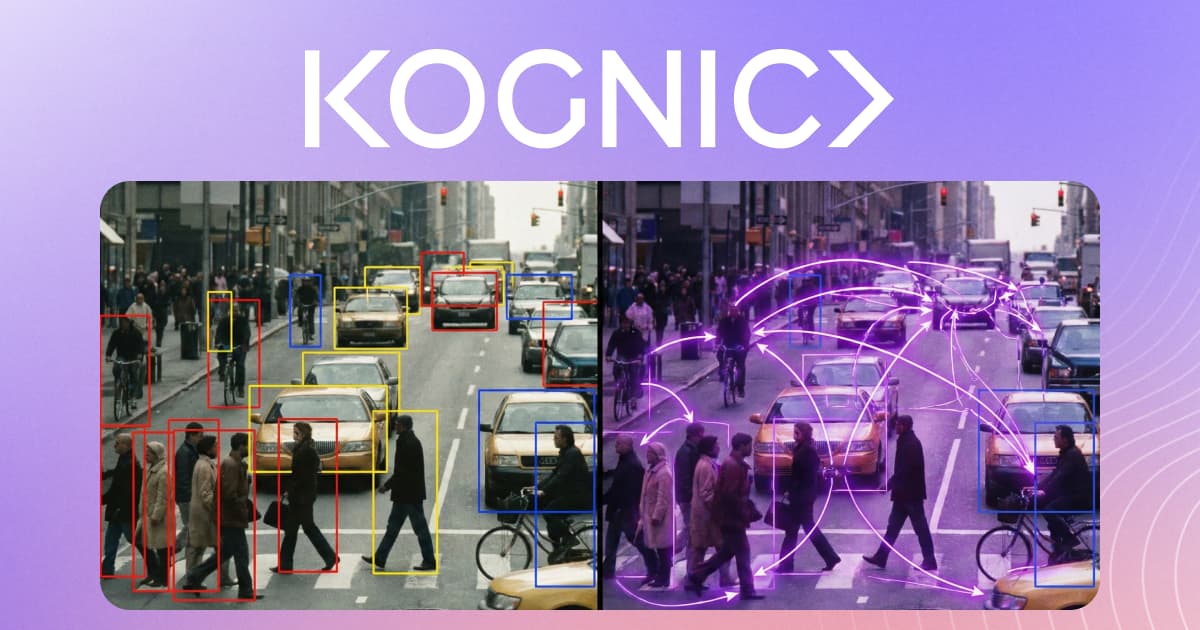
2D annotation labels objects in camera images using bounding boxes, polygons, and key points. It is used for traffic sign recognition, traffic light state, pedestrian detection, and any task where color and texture carry the signal. Cameras give a model the semantic richness that LiDAR and radar cannot, so 2D annotation remains central even in sensor-fusion programs.
Radar Annotation
Radar annotation labels radar returns, which carry velocity and range information. Radar is the sensor that holds up when conditions degrade, so it matters most for the adverse-weather and long-range cases that perception models struggle with. In a fused workflow, radar is annotated alongside camera and LiDAR rather than in isolation, so that a single object is consistent across all three views.
Sensor Fusion Annotation
Sensor fusion annotation labels camera, LiDAR, and radar data in one coordinated workflow, instead of annotating each sensor stream separately. Annotating sensors together keeps a single object consistent across views, captures cross-sensor context, and avoids the duplicated effort and drift that come from separate pipelines.
Fusion depends on calibration. Calibration matrices and timestamp synchronization align the sensor streams in space and time, and poor calibration is the largest single source of annotation error in multi-sensor work. When calibration is right, a 3D label drawn in the point cloud can be projected automatically onto the matching camera image, so an annotator works once and the label appears correctly everywhere.
For the full treatment of fusion workflows, calibration, and cross-sensor validation, see the dedicated guide: Sensor Fusion Annotation for Autonomous Vehicles.
Semantic and Instance Segmentation
Semantic segmentation classifies every pixel or point in a scene by category: road, sidewalk, vehicle, vegetation, sky. Instance segmentation goes further and separates individual objects of the same class, so two adjacent cars are labeled as two distinct instances. Segmentation gives a perception model a dense, scene-wide understanding rather than a set of boxes, which matters for drivable-space estimation and free-space detection.
Lane, Road, and Behavior Annotation
Lane and road annotation marks lane lines, road boundaries, crosswalks, and road markings. It feeds lane-keeping, path planning, and map-building. Behavior annotation, the newest category, captures what is happening in a scene and why: a cut-in, a yield, a pedestrian about to cross. This is the shift the industry is making, from labeling what is in traffic to labeling why things happen.
Kognic addresses this with Language Grounding, a capability for annotating the vision-language and vision-language-action models that the next generation of AV stacks rely on. Instead of only labeling the objects in a scene, annotators describe why events occur and what the vehicle should do.
What Are Autonomous Driving Annotation Used For?
Annotation feeds every learning-based component of an autonomous stack. The main use cases:
- Object detection. Cuboids and boxes train the model to find vehicles, pedestrians, and cyclists, and to place them accurately in 3D.
- Free space and drivable area. Segmentation tells the planner where the vehicle can go.
- Lane and road understanding. Lane annotation feeds lane-keeping and path planning.
- Prediction. Object orientation and tracked sequences let the model predict where agents will move next.
- Planning and behavior. Behavior and language annotation train the model to reason about intent and decide on an action.
- Validation. Annotated data is also the benchmark used to measure whether a model is good enough to ship.
The harder cases, the ones that decide whether a system is safe, are the rare ones: the unusual pedestrian, the occluded cyclist, the construction zone. Finding and labeling those edge cases well is where annotation quality has the most impact. See Edge Cases in Autonomous Driving for more on this.
Why Do Quality Requirements Matter So Much?
Quality requirements matter more in autonomous driving than in almost any other domain because annotation errors propagate into safety-critical decisions. A mislabeled object in training data is not a cosmetic defect. It teaches the model a wrong lesson that can surface as a missed detection on the road.
Production-grade autonomous driving annotation has to meet several standards at once:
- Geometric accuracy. Boxes and cuboids must fit objects tightly and carry the right orientation.
- Cross-sensor consistency. The same object must be labeled the same way across camera, LiDAR, and radar.
- Temporal consistency. An object must keep the same identity across a sequence of frames.
- Label-set consistency. Annotators must apply the same definitions the same way, which depends on clear annotation instructions and ongoing review.
Kognic builds quality into the workflow rather than treating it as a final inspection. Annotation work flows through a standard pipeline: annotate, quality review, expert verification, client QA, and delivery. Quality Managers review annotator work and corrections happen inside the review phase, expert verifiers check that the reviewers are catching enough errors, and the customer reviews before delivery. The platform also runs more than 90 automated quality checks built for driving scenarios, so consistent, machine-checkable errors are caught without waiting for a human. Quality is measured quantitatively through review-edit metrics like precision, recall, and geometry accuracy, and qualitatively through reviewer feedback.
How Does Annotation Fit Into the Model Development Pipeline?
Annotation is not a one-time step. It is a loop inside model development: collect data, label it, train, find where the model fails, collect more of those cases, and label again. The teams that move fastest are the ones that close that loop quickly and keep quality high while doing it.
Two mechanisms reduce manual effort without giving up control:
- Pre-labeling loads reference annotations onto a scene before annotation begins, so annotators start from a draft rather than a blank canvas. The pre-labels can come from a customer's own model or a third-party source. See Pre-labeling.
- Autobaan, Kognic's automated prediction system, runs trained models against incoming scenes and produces object detections, 3D cuboids from LiDAR and 2D boxes from cameras, each with a confidence score. Annotators see these as Copilot suggestions they can accept, reject, or adjust. Kognic's automation, which also includes multi-sensor projection, ego-motion compensation, SAM-based segmentation, object tracking, automatic box adjustment, and static-object filtering, can save up to 68% of annotation time compared with fully manual labeling.
Whichever approach a project uses, the human stays in the loop. Automation proposes, people verify. That is the design principle behind the whole platform: machines learn faster with human feedback.
Annotated data is delivered in OpenLABEL, the ASAM standard format, and converted to the customer's format on export, so it drops into an existing training pipeline without bespoke glue.
How Kognic Approaches Autonomous Driving Annotation
Kognic is built for autonomous driving, not adapted to it. The platform handles native 3D and LiDAR annotation, sensor fusion across camera and point cloud data, segmentation, lane and road annotation, and Language Grounding for vision-language models, inside one workflow with quality built in.
Teams can engage in the way that fits them. Kognic offers three models: a managed service where Kognic runs the annotation, a platform license where the customer's own team uses the platform, or a hybrid model that brings in a preferred annotation partner. See the Platform and Solutions pages for detail.
Explore the topic-specific guides:
Frequently Asked Questions
What is autonomous driving annotation?
Autonomous driving annotation is the process of labeling sensor data, including camera images, LiDAR point clouds, and radar returns, so that an autonomous vehicle's perception and planning models can learn from it. It produces the ground truth that models are trained and validated against.
What types of data are annotated for autonomous vehicles?
The main data types are camera images, LiDAR point clouds, and radar returns. Camera data is annotated with 2D boxes and segmentation, LiDAR with 3D cuboids, and increasingly all three are annotated together in a sensor fusion workflow so that one object stays consistent across every sensor.
What is sensor fusion annotation?
Sensor fusion annotation labels camera, LiDAR, and radar data in a single coordinated workflow rather than annotating each sensor separately. It keeps a single object consistent across all sensors, captures cross-sensor context, and depends on accurate calibration to align the streams in space and time.
How is annotation quality measured for autonomous driving?
Quality is measured quantitatively by comparing annotator work against reviewer corrections, which produces precision, recall, and geometry-accuracy scores, and qualitatively through reviewer feedback. On the Kognic platform, work passes through annotate, quality review, expert verification, and client QA phases, with more than 90 automated checks built for driving scenarios.
Can autonomous driving annotation be automated?
Parts of it can. Pre-labeling and automated prediction give annotators a draft to refine instead of a blank canvas, and Kognic's automation can save up to 68% of annotation time compared with fully manual labeling. Human review stays in the loop because automation proposes labels and people verify them, which is what keeps safety-critical data accurate.
Why not use a general-purpose data labeling tool?
General-purpose tools are usually adapted from 2D image labeling and struggle with 3D point clouds, multi-sensor consistency, and the quality controls autonomous driving needs. Purpose-built platforms handle native 3D annotation, sensor fusion, calibration, and driving-specific quality checks that a generic tool does not provide.
Want production-grade autonomous driving annotation?
Kognic gives autonomy teams native 3D and sensor fusion annotation, automated quality checks built for driving, and the option to run it as a managed service or in-house. Book a demo or explore the platform.
Share this
Written by