
Autonomous vehicles and robots must safely navigate the real world, and that requires integrating human feedback at scale. The Kognic Platform is an annotation platform built for autonomy data, combining optimized tools, proven workflows, and intelligent auto-label integration to help you get the most annotated sensor-fusion data for your budget.
Creating a dataset for supervised machine learning
Machine learning models learn from the data they're trained on, and for autonomous systems, that data comes from complex sensors like lidars, cameras, and radars. At Kognic, we believe annotation is programming: your labeling guidelines directly shape how your models perceive the world. Inconsistent or unclear guidelines lead to systematic errors in your dataset, which then become systematic errors in your models. Since annotation is often performed by distributed teams with diverse backgrounds, guidelines must be crystal clear and interpreted consistently by everyone.
Similarities between ML projects and traditional software projects
Just as software projects require rigorous requirements management, machine learning projects need equally rigorous annotation guidelines.
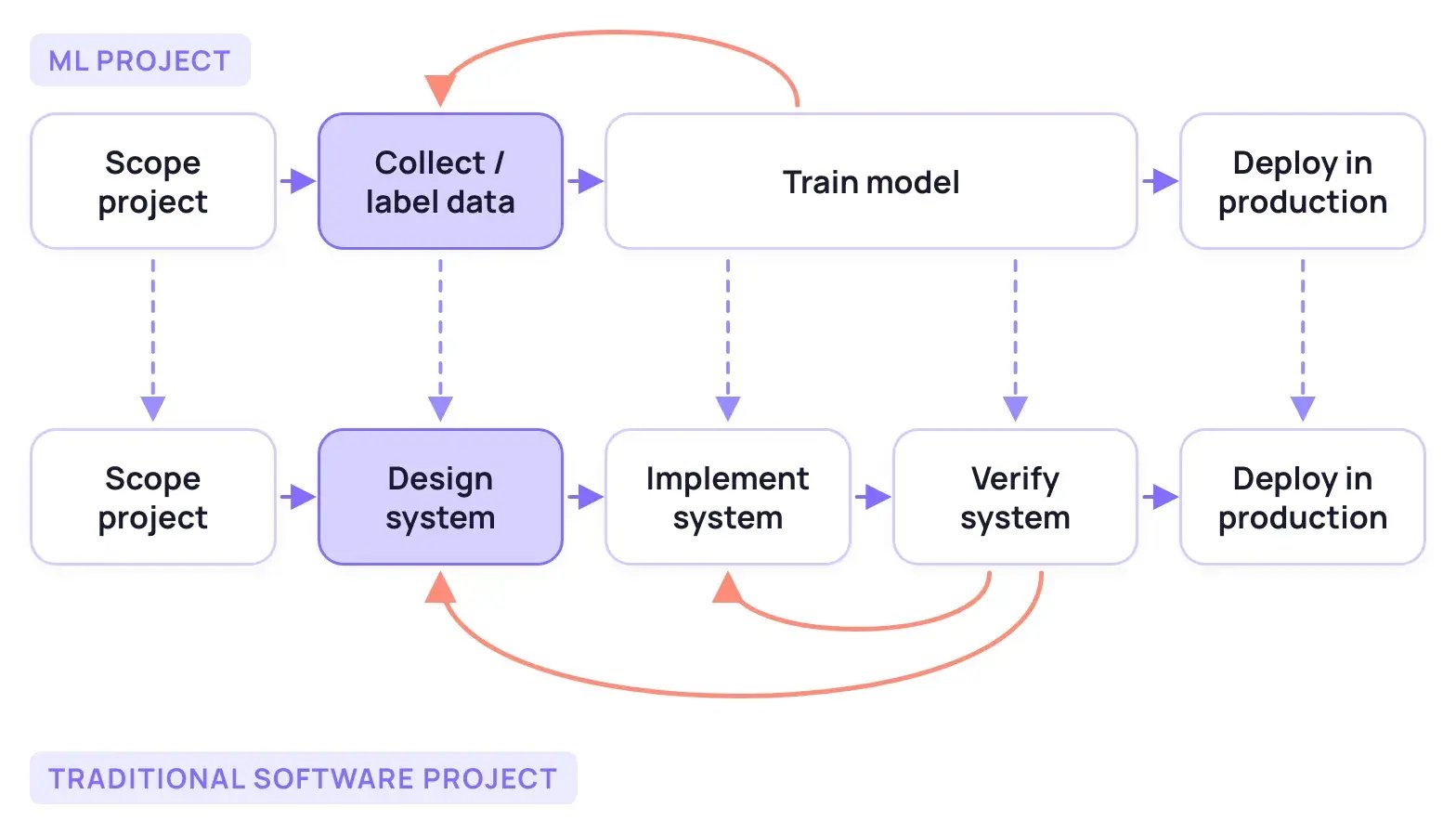
Lifecycle of an ML project vs traditional software project
In traditional software development, writing necessary, specific, understandable, accurate, feasible, and testable requirements is critical for success. The same principles apply to annotation guidelines in ML projects, yet they're often overlooked. At Kognic, we treat annotation guidelines with the same rigor as software requirements, because finding mistakes during guideline review is far cheaper than discovering them in production.
Our approach
At Kognic, we provide the tools and expertise to create, version control, and test your annotation guidelines, ensuring they capture all functional needs with zero ambiguity. Through our platform, you can validate guidelines by having multiple annotators independently annotate test cases and measure agreement levels, ensuring consistent interpretation across your entire workforce.
Guidelines change as you learn more about your data, so every change needs a record. On the Kognic platform, an annotation instruction is kept in revisions. Once a revision has been used in production it is locked, so you can always trace which version of the instruction produced a given annotation. Updates go into a new revision.
We help you maximize the value of every annotation dollar through superior productivity, quality assurance, and intelligent automation. Our Data Quality Analytics tool continuously evaluates your dataset quality and connects results back to your guidelines, enabling rapid iteration and improvement. This integrated approach, combining optimized annotation tools, proven workflows, and quality analytics, is how Kognic delivers more annotated autonomy data for your budget.
From guideline to production
A guideline only works if everyone reads it the same way: your engineers, our quality team and every annotator. That alignment happens in three stages.
Agreeing on the guideline
Before annotation starts, Kognic's team works through your use case with you and helps turn it into clear, unambiguous labeling rules. Together with a Lead Quality Manager (LQM), they remove ambiguity as early as possible. They also identify which errors your use case is most sensitive to, which sets the balance between quality and cost for the project. Questions go back and forth continuously, in Slack or in meetings, until both sides agree on what a correct annotation is.
Onboarding annotators
Human interpretation varies, so an agreed guideline still has to be taught. LQMs and Quality Managers (QMs) train each annotation team before production, then answer questions about uncertainties and edge cases as they come up. Common questions go into a shared feedback document, so every annotator benefits from each answer. Quality monitoring shows who needs more training, and only annotators who meet the quality bar move on to production tasks.
During production
Once production starts, Kognic's team reviews the dataset to find which error types exist and how severe they are for your use case, and removes systematic errors before they spread. LQMs and QMs work with annotators on what review turns up: repeated mistakes, edge cases and new clarifications from you. They pay particular attention to false negatives, false positives, 2D and 3D box dimensions, assigned classes and properties, and how annotators apply the guideline rules. The guideline stays the reference for every correction. For how we put a number on the result, see Measuring data quality efficiently.
Want to learn more? Watch the talk "It all starts with a consistent labeling guideline" held at the Gothenburg AI Alliance Conference to discover our way of working.